

This article is the second in a series about TAM penetration, written for leaders new to the concept, organizations struggling with revenue optimization, and organizations on the cusp of strategic planning or goal-setting efforts.
Organizations can fall into several recurring patterns when setting their long-term direction:
- Authoring a feel-good, abstract vision of success that doesn’t translate into measurable goals and thus measurable progress in the real world
- Defaulting to incremental improvements against internal historical baselines
- Looking within to determine “our story” and using the internal culture as their primary compass
These patterns can be useful in small doses. Pursued further, they become traps. They can feel very good because they take the pressure off in thinking critically about what progress means and what it takes. They replace reality testing with introspection. They validate ego.
But organizations don’t grow through incremental self-improvement on their own terms. As I describe in my Growth and Positioning series, all organizations survive or not based on their ability to fill, then dominate, specific niches in the external landscape. Measuring org-level success primarily against internal, historical baselines—which can feel very ambitious—reinforces the existing business without disrupting it, thereby accelerating a crash into the next local maximum.
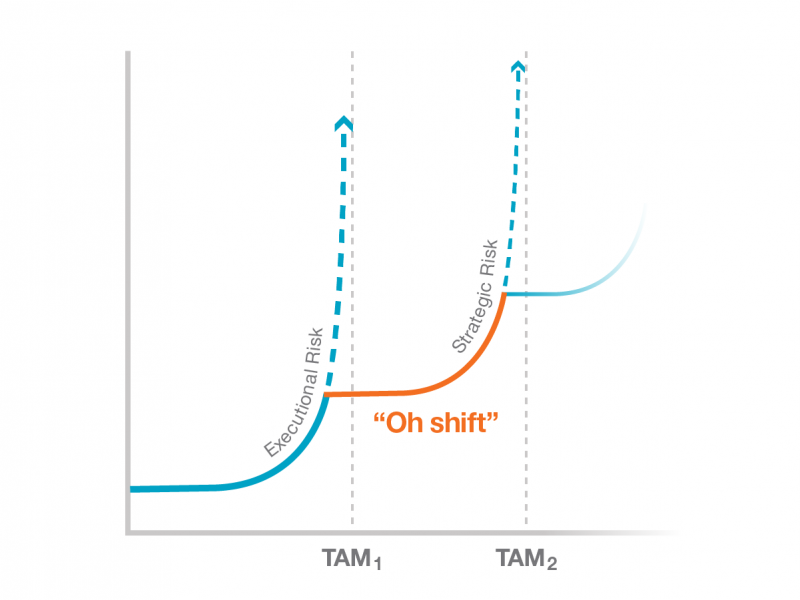
Over longer periods of time, growth is paradoxical: organizations must simultaneously maximize the existing business, build capacity for the future, and experiment their way into new forms of value creation. The latter two activities are negative-ROI and (best case) low-ROI, respectively, in the near term.
A durable way to navigate this paradox is to set goals not relative to the internal history or preference, but rather the external reality—specifically, the organization’s Total Addressable Market. As I covered in my prior post, TAM functions as a proxy for competitive context, audience saturation, and long-term opportunity.
In other words, regardless of what the CEO may say, the vision is about TAM penetration. A codified “vision” that distorts or ignores this reality may still motivate people, but it risks directing attention away from the structural work needed to continuously maintain and unlock growth.
One of the concluding slides in Alex Komoroske’s brilliant flip book Coordination Headwind: How Organizations Are Like Slime Molds depicts a single “moonshot” goal — a constant signal from the leader that helps the organization continuously evolve, step by step, towards a specific, bright future. This image echoes a well-known principle of internal and external executive communication, which is that a leader needs to repeat themselves far more than feels normal or comfortable in order to inculcate alignment and understanding.
Given the scarcity of attention internally, leaders would do well to express their organization’s vision in a way that is intellectually informed by TAM penetration. This gets everyone on the same page, and maximizes internal, cross-functional coherence. It also creates the most effective starting point specifically for revenue optimization.
More on that in my next post…
Leave a Reply