


Business thinkers have a fine-grained vocabulary for talking about a range of specific and challenging organizational milestones:
- Crisis: Something serious has gone wrong and needs immediate resolution.
- Turnaround: An organization in decline must find its way back to growth.
- Pivot: The current product and go-to-market strategy are suddenly neither viable nor scalable, and the business must switch to new ones—and make it work before funding runs out.
- Transition: The organization is making a planned operational change to a new leader, size, structure, or brand.
- Transformation: The organization has discovered a way to dramatically increase return on investment (through higher returns, lower costs, or both) without changing the fundamental business.
These specific labels are helpful. If your business is experiencing one of these moments, you want to handle it with contextual attunement and aplomb.
But there is a different, and still-difficult, moment that organizations face that is murkier, and less-well named. It’s the paradoxical moment when:
- the returns on the existing audiences, products, and operations are declining
- investing in future growth is necessary, though the cost of that change management will further reduce short-term ROI, and
- new investments are inherently speculative and experimental, which reduces short-term ROI further.
In other words, the organization needs to do three things that directly contradict each other, and spend more money, right when available funds are most scarce.

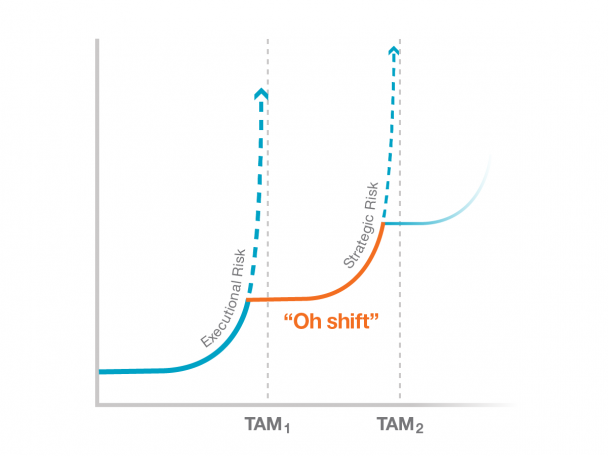
In my past writing, I’ve referred to these trilemmas as “Oh shift” moments because that captures what this kind of change, and the speed of it, feels like both cognitively and culturally.
These moments are not crises, because nothing (yet) may be wrong. They are not turnarounds, because the business may not (yet) be in decline. They are not pivots, because the TAM1 audience often remains essential. And they are not transitions or transformations, because the path forward is marked less by continuity than by discontinuity—and the end state is neither stable nor fully knowable.
Rather, they are moments when an organization is forced to hold and integrate conflicting priorities at the same time, under conditions where neither the tradeoffs nor the outcome are fully resolvable in advance.
What these moments require
These moments have some predictable, intertwined, and defining features, all the logical consequence of pursuing competing objectives at the same time.
- Positioning: The external story must evolve to accommodate legacy and new TAM segments, which means that a single value proposition (i.e., an emotional or functional benefit) is no longer clear, compelling, or correct.
- Content marketing: Telling a new, expanded story requires higher investment in cross-channel content marketing to evolve legacy perceptions, create new awareness, and develop traction around a compelling and ownable Big Idea.
- Brand and digital experience design: The visual brand must evolve, and the biggest expense in evolving a new brand is often a website… which also needs to evolve to support an expanded array of GTM activities. This makes the spec for the new website a loaded, cross-functional discussion.
- Executive leadership: The leadership posture of the CEO or Executive Director must evolve to manage a higher level of complexity.
- Operations: The most important cross-functional coordinations change, requiring shifts in business process design, internal tooling, and culture.
- Revenue leadership: The head of revenue position becomes hard to fill. It’s often a poisoned chalice for a W2 long-term hire, because they will often be held accountable for maintaining high ROI in the short term, when the external conditions necessitate a decline in ROI. Also, the best-fit skillset for the head of revenue before and after the “Oh shift” period will be different, hence these moments often lend themselves to an interim change agent leader.
And all of the above must be carefully coordinated, or else the costs compound.
“Oh shift” indeed.
What’s changed
The quick proliferation of AI over the past several years—in tandem with major geopolitical, economic, and monetary shocks—has had one consistent effect for many businesses, which is to accelerate the decline of ROI for TAM1 audiences, thereby accelerating the next “Oh shift” collision. In his revised Four Fits framework, Brian Balfour describes how AI can effectively collapse TAM1 at any point, by rendering a major channel, skill set, or product strategy fully irrelevant.

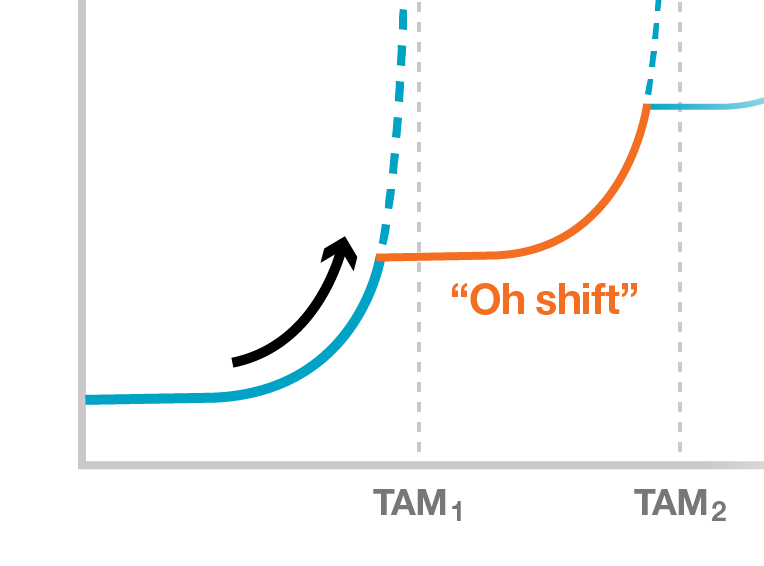
Example: A B2G cleantech startup founded in 2020 was premised on expanding government contracts, but as of 2025, those federal budgets have been cut, and its purpose-built software platform is not only misaligned with future, private-sector TAM potential, but can be substantially duplicated at low cost with AI tools. The business retains its legacy government contracts, but its future growth is speculative and fraught.
Whether you’re an opera company, a B2B startup, a solopreneur, or a health and human services nonprofit, in 2026 you are likely having an “Oh shift” moment.
The endless now
For smaller organizations, “Oh shift” moments used to come in predictable waves, separated significantly over time. Organizations could manage these changes by treating them as exceptional, until the leader or the org had gone through enough phase changes to anticipate them and address them with burned-in operational capacity.
When the waves were paced, organizations often chose to manage the tensions by structurally separating each aspect of the “Oh shift” trilemma—e.g., by having a “keep the lights on” team focused on the current business, a change management initiative outsourced to consultants, and a breakaway “Growth” team free to optimize and experiment its way to bright new futures. This at least was the influencer-driven playbook circa 2015–2020.
But as many of us said at the time, these org design moves toward increasing specialization and fragmentation within an existing business are always followed by a contraction, because the coordination cost of maintaining units with literally-competing incentives eventually torches the gains of short-term agility. Hence the period we are in now, when startups are beginning to see and name their entire organization as Engineering functions (or as “builders”), and nonprofits are integrating Development and Marketing into a single capacity focused on pan-audience user journeys.
When functions merge, the competing tensions that used to be kept apart organizationally are instead held within individual teams and brains. The formerly siloed functions no longer focus on maximizing revenue, reach, or efficiency but on optimizing across diverse opportunities and time horizons. Re-centralized organizations preserve agility not by letting specially-sanctioned teams “move fast and break things,” but by setting, top-down and in real time, which short-term opportunities are mission critical—a set of organizational priorities that can be iteratively revised and redeployed, like a code base.
When “Oh shift” ceases to be an episode and instead becomes an endless now, the change management work becomes recursive—the playbook keeps rewriting itself while the rollout is underway. Anyone deploying AI in their organization today is actively living this.
Leading while leaping
“You leapt into the abyss, but find
It only goes up to your knees” – Nick Cave
Leading inside the endless now requires a specific leadership stance. In this changed external and internal environment, being “built to last” in the Jim Collins sense becomes less important than being built to leap. Able to calibrate competing objectives—not as a one-time move, but as the repeated act of reallocating attention, capital, and effort across competing time horizons as conditions change—while still retaining the ability to move quickly and forcefully to seize specific opportunities as they arise.
I like the phrase “built to leap” because it highlights that the capacity to keep adapting can be developed and structurally embedded. Organizations don’t leap dramatically into the unknown or get there purely on heroics. They rewire themselves. They build the muscle to operate this way. With the right preparation, the leap stops being existential—it becomes just a step.
The “Oh shift” moment was never the rare event—the interval was.
And now the interval is over.
Postscript
The series below develop how “Oh shift” moments emerge, and how organizations respond.
- TAM penetration series—Why growth strategy is downstream of TAM structure
- Growth series—The mathematics of organizational growth and iterative self-disruption
- Positioning series—How story and brand must evolve as audiences and offerings expand